
Your three year old points at a stop sign and shouts "S!" A week later they are "writing" a shopping list full of squiggles and proudly reading it back to you. Those moments are the very first steps of spelling, and they arrive long before any worksheet or spelling test.
If you're wondering how to teach a 3 year old to spell, the good news is that you don't need flashcard drills or pressure. The Montessori approach builds spelling the same way children learn everything else: through their hands, their ears and short, joyful bursts of play.
This guide explains what spelling really looks like at three, the order Montessori introduces language skills, seven hands-on activities you can start this week, and the mistakes worth avoiding. For more ideas by age, see our Montessori toys for 3 year olds.
Can a 3 Year Old Learn to Spell?
Yes, but at three, "spelling" means hearing sounds and matching letters, not memorizing words.
Most three year olds are not ready to write words on paper. Their hand muscles are still developing, and that's completely normal. What they can do is notice that words are made of sounds, connect some of those sounds to letter shapes, and use ready-made letters to build simple words they can see and touch.
Every child develops at their own pace. The CDC's developmental milestones are a helpful guide to language skills at each age, but treat them as signposts rather than deadlines.
Why it matters: when you aim for sounds and letter play instead of "correct" spelling, three year olds stay curious and confident, which is exactly what makes later reading and writing easier.
How Montessori Teaches Spelling: Sounds First, Letters Second
Montessori introduces language in a simple order: listening for sounds, then linking sounds to letters, then building words, and only then writing them.
In a Montessori classroom, children often build words with movable letters before they can comfortably hold a pencil. Spelling (putting words together) usually comes before reading (taking words apart), because building a word is a hands-on activity a young child can control.
- Listen: games that tune the ear to sounds, rhymes and first letters.
- Connect: learning the sound each letter makes, using shapes children can trace and hold.
- Build: placing letters together to make short words, like cat, sun and dog.
- Write: copying letters with a pencil or chalk, once little hands are ready.
Literacy experts agree that these listening skills come first. Reading Rockets recommends rhyming, clapping syllables and playing with beginning sounds with pre-K children as the foundation for reading.
7 Montessori Spelling Activities for 3 Year Olds
The best spelling activities for three year olds are short, hands-on and led by your child's interest. Start with the first two and add more as your child grows in confidence.
1. Play "I Spy" With Sounds
Instead of "I spy something red," try "I spy something that starts with mmm." Say the letter's sound, not its name. Your child looks around for the mug, the milk or Mommy.
Why it matters: hearing the first sound in a word is the single most important pre-spelling skill. You can play anywhere: in the car, in the bath or at the grocery store.
2. Use Letter Sounds Before Letter Names
When you talk about letters, say "this is sss" rather than "this is ess." Montessori teaches sounds first because sounds are what children need to build words. "C-A-T" spoken as letter names sounds nothing like "cat," but c-a-t spoken as sounds blends naturally into the word.
Why it matters: children who know letter sounds can start building their own words much sooner.
3. Trace Letters With Fingers
Montessori uses sandpaper letters, letter shapes children trace with two fingers while saying the sound. At home you can do the same with a tray of salt or sand, or by tracing letters on your child's back. Our wooden drawing and writing board has a chalkboard side that's perfect for big, finger-sized letters.
Why it matters: tracing links the shape of a letter with its sound through movement, so letters stick in the memory.
4. Build Words With Wooden Letters
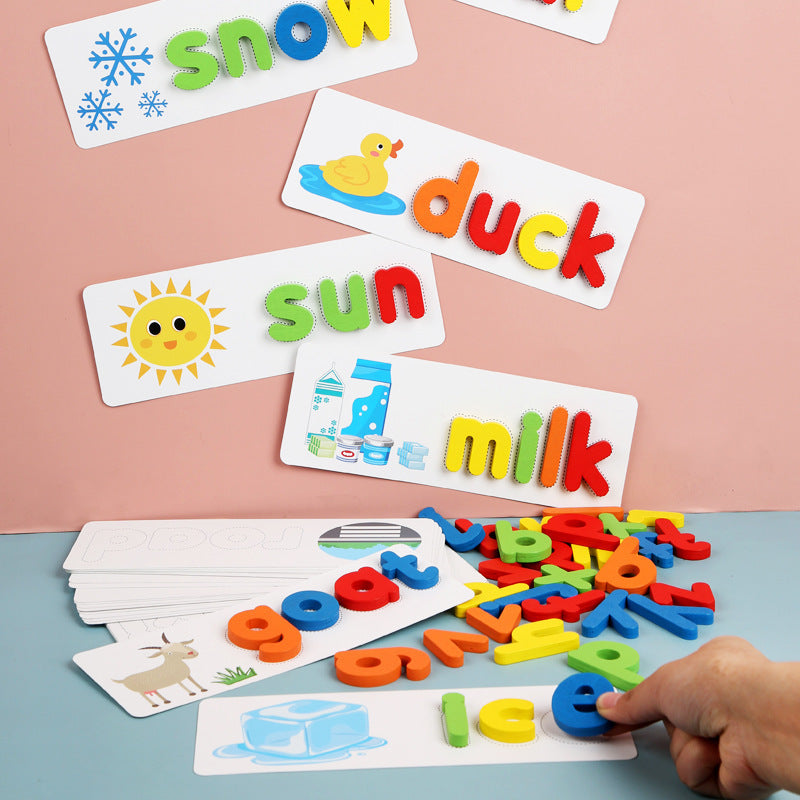
Once your child knows a handful of sounds, give them real letters to build words. A Montessori wooden spelling game makes this easy: your child picks a picture card, such as a cat or a sun, says the word slowly, then finds the wooden letters to place on the card.
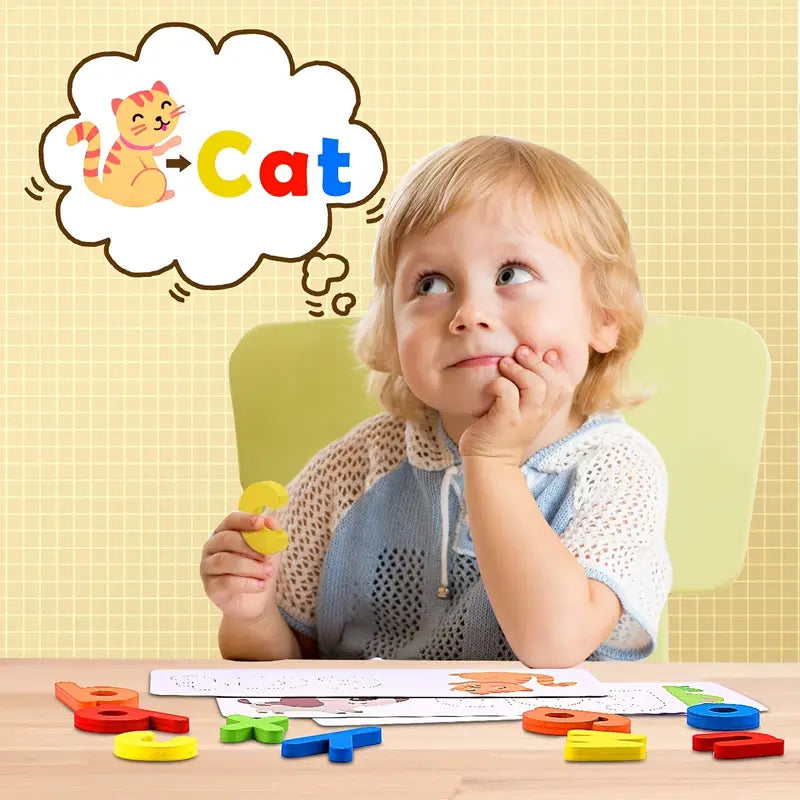
Younger children start by matching each wooden letter to the printed one. As skills grow, cover the printed word and let them spell it from the picture alone.
Why it matters: this is exactly how Montessori classrooms bridge the gap between knowing letters and spelling words, without needing a pencil.
5. Spell Their Name First
A child's own name is the most motivating word they'll ever spell. Write it in large letters, point to each one as you say the sounds together, and let them rebuild it with wooden or magnetic letters. Put their name on their cup, their bedroom door and their artwork so they see it every day.
Why it matters: many children recognize the letters in their own name first, and those letters become anchors for learning the rest of the alphabet.
6. Play Rhyming and Clapping Games
Clap out the beats in words ("ba-na-na" has three claps) and play rhyming games ("What rhymes with cat? Hat! Bat!"). Silly made-up rhymes count too; three year olds love a nonsense word.
Why it matters: rhymes and syllables teach children to hear the parts inside words, a skill they'll use every time they spell something new.
7. Talk, Read and Name Everything
Spelling depends on vocabulary: children can only spell words they know. Read together every day, name objects around the house, and narrate what you're doing. For toddlers and younger siblings, talking flash cards give independent practice hearing and repeating new words without a screen.
Why it matters: a rich spoken vocabulary is the foundation for both reading and spelling later on.
What to Expect: Spelling Skills by Age
Spelling grows in stages, and every child moves through them at their own speed. These are typical patterns, not targets.
Age 2 to 3: Listening and Noticing
Children enjoy songs, rhymes and books, and may start to notice letters in their environment, especially the first letter of their name. Focus on talking, reading and sound games.
Age 3 to 4: Sounds and First Letters
Many children learn several letter sounds, can hear the first sound in a word and enjoy building simple words with movable letters. This is the perfect age for a wooden spelling game and finger tracing.
Age 4 to 5: Building and Writing Short Words
Children start to sound out short words, spell their name and write some letters by themselves. Invented spelling ("kat" for cat) is normal and healthy; it shows your child is listening to sounds. See our Montessori toys for 4 year olds for the next step.
Easy DIY Spelling Activities at Home
You can practice spelling with things you already have. Montessori favors simple, real materials.
- Sound basket: fill a basket with three objects that start with the same sound (a cup, a car, a cat toy) and one that doesn't. Can your child find the odd one out?
- Salt tray writing: pour a thin layer of salt on a baking tray and trace letters with a finger. Shake to erase.
- Fridge word builder: use magnetic letters to spell family names and favorite foods.
- Label hunt: stick name labels on furniture (door, table, chair) and go on a "word hunt" together.
Always supervise small letters and magnets around younger siblings.
Common Mistakes to Avoid
The biggest mistake is turning spelling into a test. A few gentle rules keep it fun:
- Don't correct every error. If your child builds "dg" for dog, praise the sounds they heard and model the word later.
- Keep it short. Five to ten minutes, stopping while your child is still enjoying it.
- Follow their interest. If today it's dinosaurs, spell dinosaur words.
- Skip the screens. Hands-on materials hold attention and build fine motor skills that apps can't.
Our Favorite Montessori Spelling Toys
The right materials make spelling feel like play. These are the toys our families use most:
- Montessori Wooden Spelling Game: chunky wooden letters and picture word cards for building first words. Ages 3+.
- Talking Flash Cards: 112 picture cards that say each word aloud, great for vocabulary. Ages 1 to 5.
- Wooden Magnetic Puzzle and Writing Board: a chalkboard and whiteboard for tracing and early letter writing. Ages 2+.
- Magnetic Drawing Board: pull up beads with the magnetic pen to form letters and shapes, mess-free. Ages 3+.
Looking for more learning ideas? Read our complete guide to Montessori education.
Frequently Asked Questions
How do I teach my 3 year old to spell their name?
Write their name in large letters, say each letter's sound as you point to it, and let them rebuild it with wooden or magnetic letters. Display their name around the house so they see it daily. Most children recognize their name before they can write it.
Should I teach letter names or letter sounds first?
Montessori teaches letter sounds first, because sounds are what children blend together to build and read words. Letter names can come naturally later through songs and books.
What is a Montessori spelling game?
A Montessori spelling game uses movable letters, often wooden, so children can build words with their hands before they're ready to write. Picture cards help them choose a word and check their spelling independently.
How long should spelling practice be for a 3 year old?
Five to ten minutes is plenty. Short, happy sessions a few times a week work far better than long ones. Stop while your child still wants more.
Is it normal if my 3 year old can't spell yet?
Yes. At three, most children are still learning sounds and letters, and that's exactly where they should be. If you have concerns about your child's speech or language development, talk to your pediatrician.


Leave a comment