
Hand a toddler a box with holes in it and something wonderful happens. They turn a block over and over, try one hole, then another, frown, try again, and finally the block drops through with a satisfying clunk. That small moment of "I did it!" is exactly why the shape sorter has stayed a favorite toy for generations.
In Montessori homes and classrooms, shape sorting is more than a pastime. It's one of the first ways young children learn to notice differences, solve problems and concentrate on a task. This guide explains what a Montessori shape sorter is, the skills it builds, the right age to start, six sorting games to play, and how to choose a good one.
What Is a Montessori Shape Sorter?
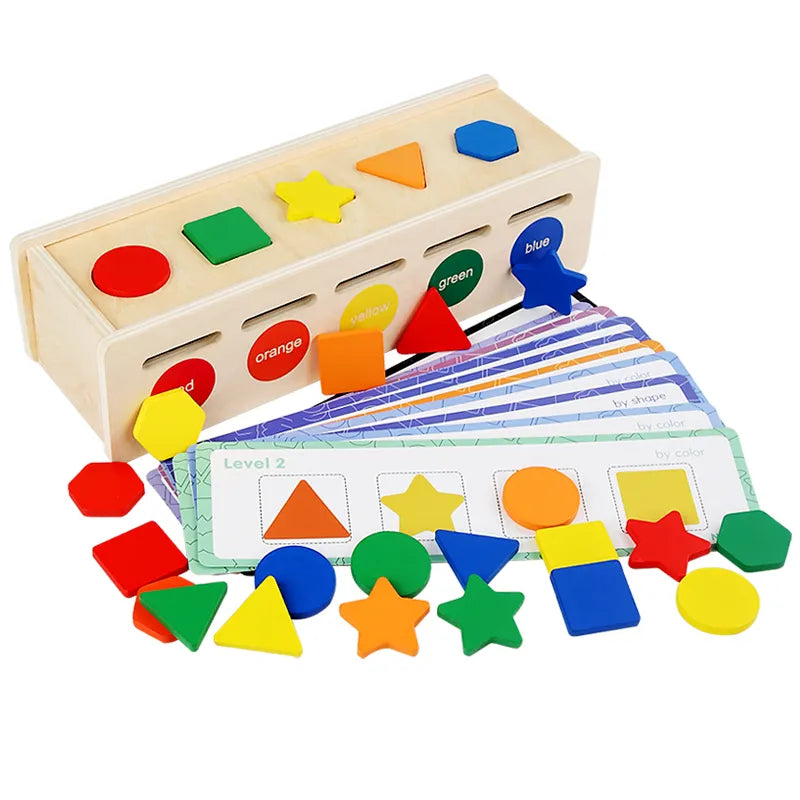
A Montessori shape sorter is a simple toy where children match blocks to the right hole or slot, usually by shape, color or both.
Classic versions are a wooden box with shaped holes in the lid. Montessori-style sorters keep the design simple and purposeful: natural materials, a small number of clear shapes and colors, and nothing that flashes or talks. The child does the thinking, and the toy shows them straight away whether a block fits.
Some sorters, like our Montessori shape sorter box, offer two ways to sort: a color side and a shape side, plus picture cards for matching games as children grow.
Why Shape Sorting Matters: 6 Skills It Builds
Shape sorting looks simple, but it exercises the hands, eyes and thinking skills all at once.
1. Shape and Color Recognition
Children learn to see the difference between a circle and a square, a triangle and a star, and red and blue. Naming each one as they play ("You found the yellow triangle!") adds vocabulary too.
2. Fine Motor Skills
Picking up a block, rotating it and lining it up with a hole takes careful finger and wrist control, the same control children later need for buttons, spoons and pencils.
3. Hand-Eye Coordination
Toddlers have to look at the hole, guide their hand and adjust when the block doesn't go in. It's a workout for coordinating what they see with how they move.
4. Problem Solving
Every block is a small puzzle: "It doesn't fit here, so where else could it go?" Children learn to test, notice what happens and try a new approach.
5. Concentration and Persistence
A shape sorter invites repetition. Many toddlers will empty and refill the box again and again, and that repetition is how focus grows.
6. Independence
Because a block either fits or it doesn't, children can check their own work without an adult saying "right" or "wrong." In Montessori this is called control of error, and it builds confidence.
What Age Should a Child Start Shape Sorting?
Most children enjoy a simple shape sorter from around 12 to 18 months, and more complex sorting games from age 2 to 3.
Readiness matters more than birthdays. Every child develops at their own pace, and the CDC's developmental milestones are a useful general guide. As a rough pattern:
- Around 1 year: children love posting objects into containers. Start with one or two large shapes, like a circle.
- Around 2 years: sorting by color and simple shapes (circle, square, triangle) becomes fun.
- Around 3 years: children can sort by shape and color, follow pattern cards and name the shapes.
If your child gets frustrated, offer fewer pieces or an easier shape. Success first, challenge later.
How to Introduce a Shape Sorter the Montessori Way
Show slowly, say little and let your child try.
- Prepare: place the sorter on a low shelf or tray with only a few blocks to start.
- Demonstrate: pick up one block, turn it slowly, find the matching hole and drop it in. Use very few words.
- Invite: "Would you like to try?" Then step back.
- Don't rescue too quickly: a little struggle is part of the learning. Help only if frustration takes over.
- Add challenge gradually: more blocks, then new shapes, then the matching cards.
6 Montessori Sorting Games to Play
One shape sorter can become many different activities as your child grows.
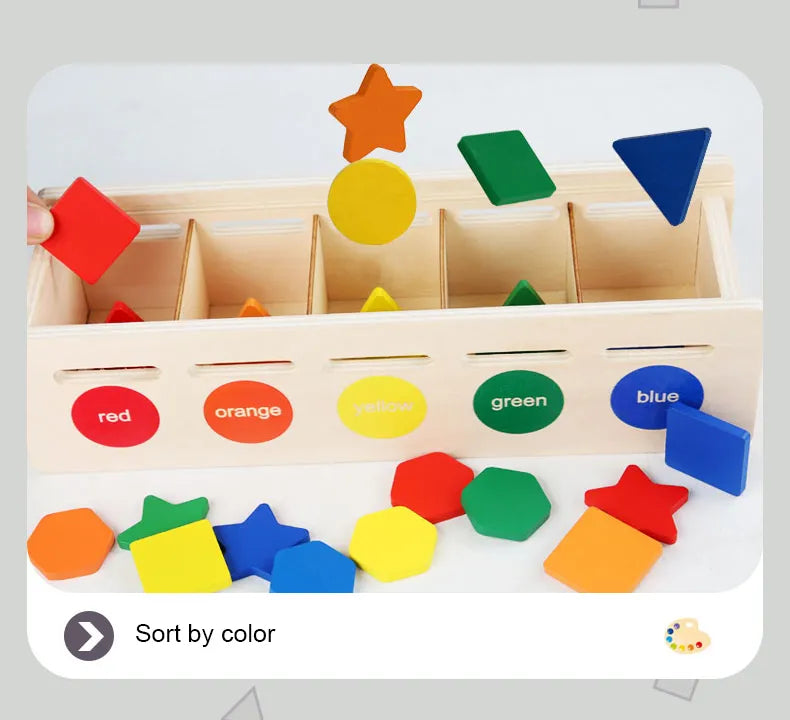
1. Color Sorting
Ask your child to put all the red blocks together, then all the blue. Our wooden sorting box has a color side made for exactly this.
2. Shape Posting
Flip to the shape side and post each block through its matching hole. Name each shape as it goes in.
3. Pattern Card Matching
Use picture cards to copy a row of shapes and colors. This builds attention to detail and early sequencing, a step toward math and reading.
4. Mystery Bag
Put a few blocks in a cloth bag. Your child reaches in, feels a shape and guesses what it is before pulling it out. This builds the sense of touch Montessori calls the stereognostic sense.
5. Sort Real Objects
Take sorting off the toy: sort socks by color, spoons and forks, or fruit by type. Real-life sorting is practical life in action.
6. Count and Sort
For older toddlers, count the blocks in each color group. "How many green blocks? Which pile has more?" Early math, no worksheets needed.
Love matching games? Our Montessori geometric eggs are another favorite for shape and color matching from 12 months.
How to Choose a Good Shape Sorter
Look for a sorter that is simple, sturdy and matched to your child's stage.
- Natural materials: smooth wood with non-toxic paint feels good in the hand and lasts for years.
- Clear shapes and colors: a handful of distinct shapes is better than lots of similar ones.
- Grows with your child: sorters with more than one way to play (color, shape, cards) stay interesting longer.
- Right-sized pieces: check the age guidance. The U.S. Consumer Product Safety Commission recommends keeping toys with small parts away from children under 3, so always supervise play.
- No batteries needed: the best sorters let the child create the action.
See more ideas in our Montessori toys for 2 year olds and Montessori toys for 1 year olds.
Frequently Asked Questions
What age is a shape sorter for?
Simple shape sorters suit most children from around 12 to 18 months. Sorters with more shapes, colors and pattern cards are better from about age 2. Always check the age guidance on the toy.
Is a shape sorter a Montessori toy?
Yes. A simple shape sorter fits Montessori principles: it focuses on one skill, uses natural materials and lets children check their own work.
Why is my toddler struggling with a shape sorter?
Turning a block to line it up with a hole is hard at first. Offer fewer pieces, start with circles (which fit any way round) and let your child watch you slowly before trying again.
What's the difference between color sorting and shape sorting?
Color sorting is usually easier because children only need to match what they see. Shape sorting adds rotation and spatial thinking, so it often comes a little later.
How do I keep a shape sorter interesting?
Rotate it off the shelf for a week, then bring it back with a new challenge: color only, shape only, pattern cards or the mystery bag game.


Leave a comment